
Engineering materials · 3dtrcek
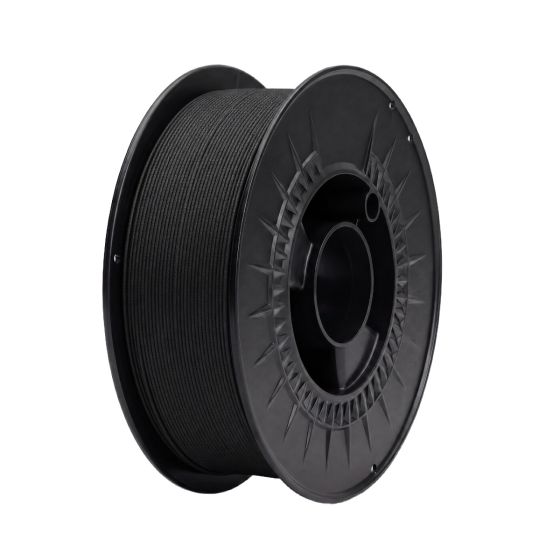
ASA CF Filament
Need a material for outdoor conditions that won’t give up? Our ASA CF combines the UV resistance of ASA with carbon fibre for exceptional stiffness, a matte finish and dimensional stability — ideal for automotive, drones and functional parts exposed to the sun.
UV & weather resistance
Carbon fibre reinforced
Exceptional stiffness
Matte finish
UV
Weather resistance
ASA base
8100 MPa
Tensile modulus
ISO 527
97°C
Vicat temperature
ISO 306
21 kJ/m²
Impact strength (Charpy)
Izod · ISO 180
Why ASA CF instead of ABS CF or PETG CF?
ASA is the only widely used base polymer that retains its mechanical properties and colour even after years of sun exposure. ABS yellows and becomes brittle in the sun, PETG loses stiffness. With added carbon fibre, ASA CF also gains significantly higher stiffness and dimensional stability — parts stay flat, accurate and strong, even outdoors. For functional outdoor parts there is no better choice.
Technical specifications
Mechanical properties
| Tensile strength (at break) | 75 MPaISO 527 |
| Tensile (elastic) modulus | 8100 MPaISO 527 |
| Elongation at break | 2,0 %ISO 527 |
| Charpy impact (unnotched) | 21,0 kJ/m²ISO 179-1eU · 23°C |
| Charpy impact (notched) | 8,0 kJ/m²ISO 179-1eA · 23°C |
| Material character | Stiff & UV-resistantHigh E-modulus = 8100 MPa; ASA = most UV-resistant base |
| Base polymer | ASA + carbon fibrePFAS-free |
Thermal & physical properties
| Vicat softening temp. | 97°CISO 306 · 50 N |
| HDT @ 0,45 MPa | 96°CISO 75 |
| HDT @ 1,81 MPa | 96°CISO 75 |
| Density | 1,09 g/cm³ISO 1183 |
| UV / weather resistance | ExcellentASA base |
| Surface | Matte blackCF texture |
| PFAS-free | Yeseco-friendly |
Print settings (FDM)
A hardened nozzle is MANDATORY
Carbon fibre is highly abrasive — it destroys a brass nozzle within a few hundred hours of printing. Use a hardened steel nozzle, we recommend 0.6 mm ✅ for worry-free printing over many hours without clogs. A 0.4 mm nozzle ❗ can also be used without issues, but with a higher chance of clogging (not recommended for longer prints). A 0.2 mm nozzle ❌ is not recommended at all.
| Parameter | Value | Notes |
|---|---|---|
| Drying temperature | 65-70°C | Too high a drying temperature can deform the spool (<70°C) |
| Drying time | 2–4 ur | Ideally also during printing |
| Nozzle temperature | 245–285°C | Start at 260°C; adjust as needed |
| Bed temperature | 90–110°C | PEI (smooth or textured) |
| Chamber temperature | ~65°C recommended | Possible without; a chamber reduces warping |
| Print speed | ≤ 200 mm/s | Lower for higher-quality parts |
| Cooling fan | 0–30 % | Low for layer strength; more only for overhangs |
| Brim | Recommended | 5–10 mm |
| Nozzle | Hardened 0.6 mm | 0.4 mm OK, 0.2 mm ❎ |
| Storage | Sealed + desiccant | Drying before use is recommended; keep dry. |
Comparison: ABS GF vs ASA CF vs ASA
| Property | ABS GF with glass fibre |
ASA CF with carbon fibre |
ASA without fibre |
|---|---|---|---|
| UV / weather resistance | ● Poor ABS base yellows and becomes brittle in the sun |
● Excellent ASA base keeps colour and properties even after years outdoors |
● Excellent ASA base, equally UV-resistant as ASA CF |
| Stiffness (modulus) | ● Very high Glass fibre greatly increases stiffness |
● Highest Carbon fibre gives the highest stiffness |
● Moderate No reinforcement — standard ASA stiffness |
| Weight | ● Higher Glass is denser than carbon |
● Low Carbon fibre adds stiffness with minimal weight change |
● Lowest No fillers |
| Surface | Matte, slightly rough | Matte black, technical look | Smooth, semi-gloss |
| Typical applications | Indoor functional parts, jigs, brackets, engineering parts not exposed to the sun | Rigid outdoor parts: automotive, drones, functional tools, robotics — where stiffness and UV resistance are essential | Outdoor housings, covers, cosmetic parts, signage — where fibre stiffness is not needed |
All three materials print in an enclosure. ABS GF and ASA CF require a hardened nozzle (the fibres are abrasive); pure ASA can be printed with a brass nozzle.
Applications
Automotive & exterior
Exterior brackets, spoilers, mirror housings, off-road vehicle parts — where sun and weather destroy ordinary materials.
Drones & RC models
Drone frames, camera mounts, wings and fuselages of RC aircraft — high stiffness at low weight, resistance to sun and vibration.
Outdoor equipment
Solar-panel mounts, outdoor sensor housings, garden and agricultural equipment — parts that must last years outdoors.
Cycling & sport
Light and computer mounts, bottle cages, protective parts — rigid, lightweight and UV-resistant gear for outdoor use.
Functional tools
Jigs, brackets and tools with high stiffness requirements — CF reinforcement ensures minimal bending under load.
Robotics & automation
Robotic arms, sensor mounts, structural parts — where stiffness and dimensional stability over time are essential.
Key features
UV resistance — for outdoor use
The ASA base does not yellow, does not become brittle and keeps its mechanical properties even after years in the sun. The right choice for parts that live outdoors.
Carbon fibre — stiffness without weight
CF reinforcement significantly increases stiffness and dimensional stability with minimal added weight. Parts bend and warp less.
Matte finish — professional look
The CF texture hides layer lines and gives parts a technical, matte-black look straight off the printer — no post-processing.
Frequently asked questions
1
Do I need a hardened nozzle to print ASA CF filament?Yes, without exception. Carbon fibre is extremely abrasive and wears out a brass nozzle within a few hundred hours, causing inaccurate extrusion and poor prints. Use a hardened steel, ruby or carbide nozzle. We recommend a 0.6 mm diameter for better fibre flow and less clogging.
2
What is the difference between ASA CF and ABS CF?UV resistance. The mechanical properties are similar, but ABS CF yellows in the sun, the surface becomes brittle and the part loses strength over time. ASA CF keeps its colour, surface and mechanical properties even after years of outdoor use.
3
Does ASA CF need an enclosure?It is recommended, but not as critical as with pure ASA or ABS. Carbon fibre significantly reduces shrinkage and warping, so smaller parts print successfully even without an enclosure. For larger parts and the best dimensional accuracy we still recommend an enclosure. A brim is recommended for all parts.
4
How do I finish the surface after printing?In most cases no finishing is needed — the matte CF surface already looks professional and hides layer lines. Sanding is possible but exposes the fibres and changes the texture. Acetone smoothing works poorly. It can also be machined (drilling, milling, turning).
5
Is ASA CF suitable for AMS / multi-spool systems?Yes, keeping in mind that CF filaments are more brittle than regular ones and sharp bends in AMS tubing can cause breaks. CF filaments also cause increased wear of moving parts in AMS systems. A stable diameter (±0.05 mm) and precise winding make use possible, but we recommend keeping the filament path as straight as possible.
Ready to order?
Technical documentation and volume pricing available
Full technical data sheet on request. Our team helps you choose the right material for your application.
Close
- -30%
Please complete your information below to login.
Sign In
Create New Account