
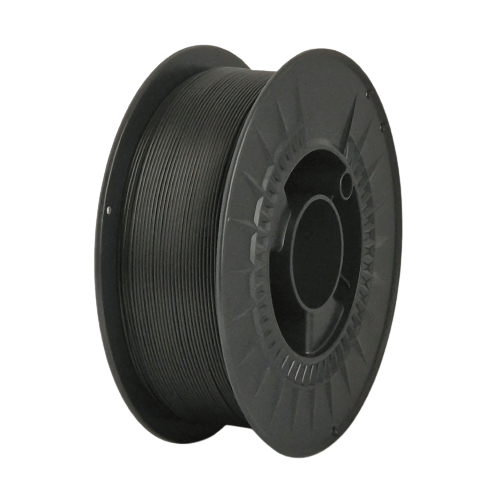
ABS ESD filament
As low as
€89.99
inc. VAT
In stock
Only %1 left
SKU
000028517031
PROTECT YOUR ELECTRONICS
⭐ Controlled Dissipation of Static Charges
⚡ Protect Circuit Boards, Sensors, Microcontrollers
✨ Longevity and Reliability for Sensitive Electronic Components
❤️ Perfect for Arduino and Raspberry Pi Housings
- Diameter: 1.75mm +/- 0.03mm
- Neating Winding, Smooth Feeding
ESD Materials · 3dtrcek
ABS ESD Filament
Permanent electrostatic discharge protection — conductive carbon black dispersed throughout every layer. Not a coating, not a treatment. Built in.
Carbon Black Additive
IEC 61340-2-3 Certified
Electrically Conductive
Humidity-Independent
~10⁴ Ω
Surface Resistivity
IEC 61340-2-3
<10³ Ω·cm
Volume Resistivity
IEC 61340-2-3
100°C
Vicat Softening
ISO 306/A
2,020 MPa
Flexural Modulus
ISO 178
Why conductive range?
Most ESD filaments target the dissipative range (10⁶–10⁹ Ω). This filament sits in the conductive range (~10⁴ Ω) — charge drains almost instantly. For component trays, handling fixtures, and ESD packaging where charge must reach ground through the part, conductive-range performance is faster, more reliable, and the correct specification.
Technical Specifications
Electrical Properties
| Surface Resistivity | ~1.0 × 10⁴ ΩIEC 61340-2-3 |
| Volume Resistivity | <1.0 × 10³ Ω·cmIEC 61340-2-3 |
| Classification | Electrically Conductive |
| ESD Stability | PermanentNot humidity-dependent |
| Additive | Conductive Carbon Black |
Mechanical & Thermal
| Tensile Strength (yield) | 26.0 MPaISO 527-2 |
| Tensile Strength (break) | 20.0 MPaISO 527-2 |
| Elongation at Break | 25%ISO 527-2 |
| Flexural Modulus | 2,020 MPaISO 178 |
| Impact Strength (Izod) | 9.0 kJ/m²ISO 180/A · 23°C |
| Shore D Hardness | 73ISO 868 · 15 sec |
| HDT (1.8 MPa) | 67°CISO 75-2/A |
| Vicat Softening Temp. | 100°CISO 306/A |
Print Settings (FDM)
Drying is mandatory
Dry at 65°C for 2–3 hours before every print. Moisture disrupts the carbon black network and produces parts that fail ESD testing — even if they look correct.
| Parameter | Value | Notes |
|---|---|---|
| Drying Temperature | 65°C | Mandatory before printing |
| Drying Time | 2–3 hours | Longer in humid conditions |
| Nozzle Temperature | 200–230°C | Do not exceed 230°C melt temp |
| Bed Temperature | 90–110°C | PEI sheet recommended |
| Enclosure | Required | 40–55°C ambient target |
| Print Speed | 30–50 mm/s | Slower = better ESD consistency |
| Min. Infill (ESD parts) | 40% | Below 40% breaks Z-axis conductivity |
| Cooling Fan | Off / ≤15% | Prevents warping and delamination |
| Storage | Sealed + desiccant | Re-dry after 24h open air |
Industry Applications
PCB Assembly
Component trays, PCB holding jigs, test fixtures, and probe guides for SMD and through-hole assembly lines.
Semiconductor
IC carriers, JEDEC tray replicas, wafer cassette spacers, and burn-in socket inserts for fab environments.
Automotive Electronics
ECU assembly fixtures, ADAS sensor testing brackets, and HV battery module handling trays for IATF 16949 lines.
Aerospace & Defence
Avionics bay component mounts, conformal coating masks, and connector protectors for low-volume critical assemblies.
Industrial Automation
ESD-safe gripper fingers, robotic component presentation trays, and ATE sensor mounts in automated test racks.
ESD Packaging
Custom transit trays for electronic components — direct replacement for injection-moulded ESD packaging with no tooling cost.
Key Properties
Permanent ESD Protection
Carbon black dispersed throughout the polymer matrix — not a surface coating. ESD performance does not degrade with age, cleaning, or humidity variation.
Certified Electrical Data
Resistivity values measured per IEC 61340-2-3. Supports ANSI/ESD S20.20 and IEC 61340-5-1 compliance documentation. Datasheet on request.
On-Demand ESD Tooling
Replace injection-moulded ESD trays and fixtures with 3D printed parts — no tooling cost, no minimum order, custom geometry in days.
Frequently Asked Questions
Parts printed with correct settings achieve surface resistivity around 10⁴ Ω (IEC 61340-2-3) — in the electrically conductive range. Charge drains almost instantly, making it ideal for ESD packaging, component trays, and handling fixtures where charge reaches ground through the part.
Yes — drying is mandatory. Dry at 65°C for 2–3 hours before printing. Moisture disrupts the carbon black conductive network and produces parts that fail ESD testing — even if they look correct. Store unused filament with desiccant in a sealed container.
Do not apply standard paints, lacquers, or insulating coatings to any ESD contact surface — they eliminate ESD protection at that surface. Sanding and light acetone smoothing are safe. If a topcoat is needed, use ESD-safe coatings and test the finished part after application.
Any FDM printer with a heated bed reaching 100°C and a fully enclosed print chamber. Open-frame printers are not suitable for production parts. Use a standard brass nozzle for prototyping and hardened steel for sustained production runs.
No. The carbon black additive is uniformly dispersed throughout the polymer matrix and does not evaporate, wash off, or degrade with age. Printed parts maintain their electrical properties for the full service life — provided no insulating coating is applied to the ESD surface.
Need more information?
Technical documentation & bulk pricing available
Full datasheet on request. Our team can help you select the right ESD material for your application.
Close
- -35%
 Someone purchased a
PETG filament
a few minutes ago from BerlinAs low as €14.29inc. VATRegular Price €21.99inc. VAT
ABS ESD filament

Please complete your information below to login.
Sign In
Create New Account